
Understanding Carpet Area Vs Super Built-Up Area Vs Built-Up Area To Make Smarter Real Estate Investment Decisions
Mansi Ranjan | TOI Homes Agency | Mar 25, 2026, 18:33 IST
Stop paying for space you cannot use by mastering the differences between Carpet Area, Built-Up Area, and Super Built-Up Area. Our comprehensive guide simplifies complex real estate jargon, provides essential calculation formulas, and explains RERA mandates. Learn how to calculate the actual living space of your dream home versus the saleable area to ensure you get exactly what you pay for.

While purchasing a home, it is important to understand the differences between Carpet Area, Built-up Area, and Super Built-up area. These measurements decide what you are paying for. Knowing these terms will help you make an informed decision when buying property.
In this guide, we will explain these terms, provide the formulas you need to calculate them.
![Carpet-area-infographic]()
Carpet Area = the space you actually live in
Put simply, the Carpet Area is the area where you can literally spread a carpet. It is the net usable floor area of an apartment. This includes the space in your bedrooms, living room, kitchen, and bathrooms.
Think of it as the “inner-wall-to-inner-wall” measurement. It represents the actual living space you will occupy on a daily basis..
What’s Included:
Use this basic formula to calculate the carpet area of your property:
Carpet Area = Sum of net usable area of all rooms (Bedroom + Living Room + Kitchen + Bathrooms + Internal Hallways)
What is
Carpet Area is a general term. RERA Carpet Area on the other hand is the legal definition mandated by the Real Estate Regulatory Authority. The RERA guidelines ensure that builders cannot manipulate this figure to mislead buyers.
The key distinction is that RERA Carpet Area includes the thickness of internal partition walls but excludes external walls, balconies, and terraces.
Additionally, if the final carpet area is less than what was promised (beyond a 3% margin), the builder must refund the money with interest. This is high-value info for a buyer.
Pro Tip: When a builder quotes a price today, the law requires them to base that price specifically on the RERA Carpet Area. If you see a price quoted only on “Super Built-Up Area,” consider it a significant transparency issue.
![Built-up-area-infographic]()
Built-Up Area = Carpet Area + walls, balconies & enclosed spaces
The Built-Up Area is the total footprint of your apartment. In simple terms, the Built-Up Area is everything within the outer boundaries of your specific flat. It is usually 10% to 15% larger than the carpet area.
What’s Included:
Find the formula below to calculate Built Up Area:
Built-up area = Carpet area + area of walls + area of balcony
Homebuyers often use this metric to understand the total “enclosed” space they own.
![Super-Built-Up-Area-Infographic]()
Super Built-Up Area is your home and your share of the lifestyle
The Super Built-Up Area, also known as the Saleable Area. It is the figure developers highlight in marketing materials. They represent your private Built Up Area plus your proportionate share of the building's common amenities.
Since you use the elevator, travel through the lobby, and visit the clubhouse, the builder adds some of those spaces to your unit's square footage.
What’s Included:
The Super Built-Up Area is calculated using a Loading Factor.
Super built-up area = Built-up area + common areas (stairs, lobbies, lift, pool etc.)
Or
Super Built-Up Area = Carpet Area X (1 + Loading Factor)
In most urban Indian markets, a fair loading factor typically ranges between 25% and 35%. If the loading exceeds 40%, you are paying a high premium for common amenities relative to your actual living space.
To visualize the difference, imagine a 1,200 sq. ft. apartment (Super Built-Up).
Carpet Area (~850 sq. ft.): The actual floor you walk on.
Built-Up Area (~1,000 sq. ft.): The floor + the walls + your balcony.
Super Built-Up Area (1,200 sq. ft.): Your home + your slice of the lobby and pool.
When looking to buy a home, real estate agents or builders can throw these jargons at you, which can lead to confusion, such as what is carpet area or built up space vs carpet area. Remember that if you want to avoid being duped, you must understand the meaning of these words as well as the calculating method. We hope this material is helpful in this regard.
Ready to see how these measurements look in real life? Visit TOI Homes to explore verified listings where we clearly highlight the RERA Carpet Area for every project. We help you cut through the marketing jargon so you can find a home that fits your needs and your budget.
Note: RERA rules may vary slightly by state (e.g., MahaRERA vs. HRERA). Always check your specific state’s portal for local notification nuances.
Disclaimer: The information presented by TOI Homes, part of The Times of India Group, is for general informational purposes only and does not constitute financial, legal, or investment advice. All data and insights are based on sources believed to be reliable but are not guaranteed for accuracy or completeness and are subject to change due to market conditions. The developer and associated entities are not liable for decisions made based on this information. Real estate investments involve risks, and buyers are advised to conduct independent due diligence and consult certified advisors before investing. TOI Homes does not endorse or promote any specific property or developer unless explicitly stated.
Q1. What is the Carpet Area definition as per RERA?
Ans: As per RERA, carpet area is the net usable floor area of an apartment, excluding external walls, exclusive balconies/verandahs, and open terraces. It includes the area covered by internal partition walls.
Q2. Is thesuper built up area the same as carpet area?
Ans: No, super built-up area is not the same as carpet area. The carpet area is the net usable floor area inside your apartment walls. While super built-up area is larger, saleable area that includes the carpet area plus wall thickness, balconies, and a proportionate share of common spaces like lobbies, lifts, and staircases.
Q3. What is the loading factor?
Ans: The loading factor is the percentage of a property's total area (super built-up area) allocated to common spaces, such as lobbies, staircases, and amenities, rather than the private usable space (carpet area).
Q4. What is the difference between build-up and carpet area?
Ans: Carpet area is the actual net usable floor area (70-85% of built-up) where you can lay a carpet. The built-up area is the total covered area, including the carpet area, internal partition walls, and balcony/utility areas.
In this guide, we will explain these terms, provide the formulas you need to calculate them.
What is Carpet Area?
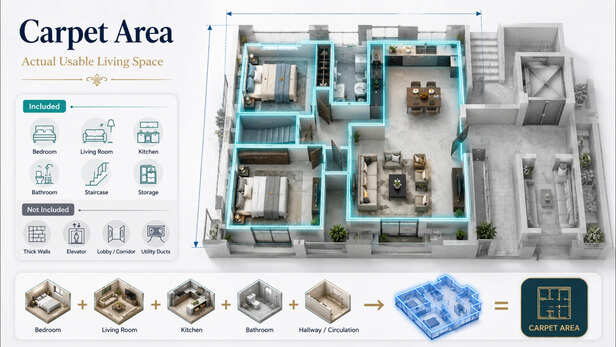
Carpet Area = the space you actually live in
Put simply, the Carpet Area is the area where you can literally spread a carpet. It is the net usable floor area of an apartment. This includes the space in your bedrooms, living room, kitchen, and bathrooms.
Think of it as the “inner-wall-to-inner-wall” measurement. It represents the actual living space you will occupy on a daily basis..
What’s Included:
- All rooms (Living, Dining, Bedrooms)
- Kitchen and Bathrooms
- Internal staircases (in the case of duplexes)
- Internal hallways and storage closets
- External walls
- Common areas (lobby, lift, etc.)
- Utility ducts and shafts
Formula to Calculate Carpet Area
Carpet Area = Sum of net usable area of all rooms (Bedroom + Living Room + Kitchen + Bathrooms + Internal Hallways)
What is RERA Carpet Area ?
The key distinction is that RERA Carpet Area includes the thickness of internal partition walls but excludes external walls, balconies, and terraces.
Additionally, if the final carpet area is less than what was promised (beyond a 3% margin), the builder must refund the money with interest. This is high-value info for a buyer.
Pro Tip: When a builder quotes a price today, the law requires them to base that price specifically on the RERA Carpet Area. If you see a price quoted only on “Super Built-Up Area,” consider it a significant transparency issue.
What is Built-Up Area?
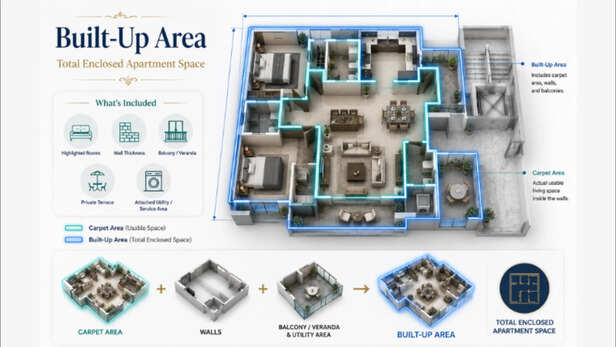
Built-Up Area = Carpet Area + walls, balconies & enclosed spaces
The Built-Up Area is the total footprint of your apartment. In simple terms, the Built-Up Area is everything within the outer boundaries of your specific flat. It is usually 10% to 15% larger than the carpet area.
What’s Included:
- Everything in the Carpet Area
- The thickness of both internal and external walls
- Exclusive balconies and verandas
- Private terraces or service shafts attached to the unit
Formula to Calculate Built-Up Area
Built-up area = Carpet area + area of walls + area of balcony
Homebuyers often use this metric to understand the total “enclosed” space they own.
What is Super Built-Up Area?
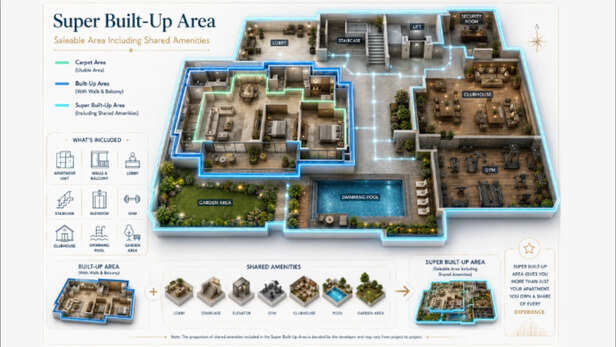
Super Built-Up Area is your home and your share of the lifestyle
The Super Built-Up Area, also known as the Saleable Area. It is the figure developers highlight in marketing materials. They represent your private Built Up Area plus your proportionate share of the building's common amenities.
Since you use the elevator, travel through the lobby, and visit the clubhouse, the builder adds some of those spaces to your unit's square footage.
What’s Included:
- Total Built-Up Area
- Proportionate share of the lobby, staircases, and lift shafts
- Shared amenities like the gym, clubhouse, and swimming pool
- Security rooms and common garden areas
Formula to Calculate Super Built-Up Area
Super built-up area = Built-up area + common areas (stairs, lobbies, lift, pool etc.)
Or
Super Built-Up Area = Carpet Area X (1 + Loading Factor)
In most urban Indian markets, a fair loading factor typically ranges between 25% and 35%. If the loading exceeds 40%, you are paying a high premium for common amenities relative to your actual living space.
Difference Between Carpet Area, Super Built-Up Area, and Built-Up Area
Carpet Area (~850 sq. ft.): The actual floor you walk on.
Built-Up Area (~1,000 sq. ft.): The floor + the walls + your balcony.
Super Built-Up Area (1,200 sq. ft.): Your home + your slice of the lobby and pool.
| Feature | Carpet Area | Built-Up Area | Super Built-Up Area |
|---|---|---|---|
| Usable Floor Space | Yes | Yes | Yes |
| Internal Walls | Yes (under RERA) | Yes | Yes |
| External Walls | No | Yes | Yes |
| Private Balcony | No | Yes | Yes |
| Lifts & Lobbies | No | No | Yes |
| Clubhouse/Gym | No | No | Yes |
Conclusion
Explore RERA Approved Projects with TOI Homes
Note: RERA rules may vary slightly by state (e.g., MahaRERA vs. HRERA). Always check your specific state’s portal for local notification nuances.
Disclaimer: The information presented by TOI Homes, part of The Times of India Group, is for general informational purposes only and does not constitute financial, legal, or investment advice. All data and insights are based on sources believed to be reliable but are not guaranteed for accuracy or completeness and are subject to change due to market conditions. The developer and associated entities are not liable for decisions made based on this information. Real estate investments involve risks, and buyers are advised to conduct independent due diligence and consult certified advisors before investing. TOI Homes does not endorse or promote any specific property or developer unless explicitly stated.
FAQs:
Ans: As per RERA, carpet area is the net usable floor area of an apartment, excluding external walls, exclusive balconies/verandahs, and open terraces. It includes the area covered by internal partition walls.
Q2. Is the
Ans: No, super built-up area is not the same as carpet area. The carpet area is the net usable floor area inside your apartment walls. While super built-up area is larger, saleable area that includes the carpet area plus wall thickness, balconies, and a proportionate share of common spaces like lobbies, lifts, and staircases.
Q3. What is the loading factor?
Ans: The loading factor is the percentage of a property's total area (super built-up area) allocated to common spaces, such as lobbies, staircases, and amenities, rather than the private usable space (carpet area).
Q4. What is the difference between build-up and carpet area?
Ans: Carpet area is the actual net usable floor area (70-85% of built-up) where you can lay a carpet. The built-up area is the total covered area, including the carpet area, internal partition walls, and balcony/utility areas.