
Key Real Estate Terms Every Homebuyer Must Know To Navigate The Property Market With Absolute Confidence
Mansi Ranjan | May 15, 2026, 17:29 IST
Master the essential vocabulary of the real estate industry to protect your investment and avoid costly mistakes. This comprehensive glossary explains critical concepts from carpet area and super built-up area to RERA compliance and encumbrance certificates. Empower yourself with the knowledge needed to decode builder jargon, understand legal documentation, and manage home loan financial terms for a seamless property buying experience.

Home buying is one of the biggest financial decisions you’ll ever make. However, for many first-time buyers, the process can feel overwhelming if they are unfamiliar with the basic terminology of real estate.
From carpet area to circle rate, these terms directly impact your investment, pricing, and ownership rights. Understanding these terms is not just helpful; it is essential.
If you are planning to invest in property, here are some of the real estate terms every homebuyer should know before investing.
Real estate is not only about location and budget. But it is also about clarity and making informed decisions.
When you understand these terms, you can:
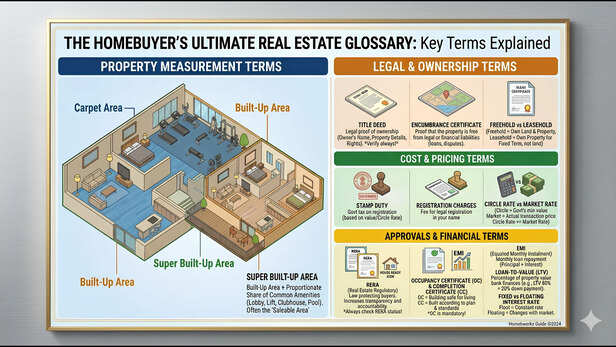
![Infographic-for-understanding-basic-real-estate-terms]() Here are some of the basic property measurement terms you must know about:
Here are some of the basic property measurement terms you must know about:
Carpet area is the actual usable space inside your home. It is the area where you can literally lay a carpet.
It includes: Bedroom, living room, kitchen, bathrooms
It excludes: Walls, balconies, and common areas
The built-up area includes: Carpet area, internal and external walls, and balcony space. It is usually 10-15% larger than the carpet area.
The super built-up area includes: Built-up area, shared/common areas like lobby, lift, and clubhouse. It is also known as the Saleable Area. Several builders often quote prices on the basis of super built-up area, which is why it is important to understand this term.
These are some basic legal and ownership terms you should know before beginning your property buying journey.
Freehold Property means you own the land and property completely. Whereas in a leasehold property, you own the property for a fixed period, not the land.
Freehold property is generally preferred for long-term investment and resale value.
2.
A title deed is the legal document that proves ownership of the property. It includes:
An encumbrance certificate confirms that the property is free from legal or financial liabilities, such as loans or disputes. This is a must-have document before finalizing any property deal.
Learn about the basic key cost and pricing terms:
1.
Stamp duty is a government tax that is paid during property registration. It is calculated based on: Property value and circle rate.
2.
Registration charges are paid when you want to legally register the property in your name. It typically ranges from 1% of the property’s market value.
Circle rate is the minimum property value set by the government for a specific area. It is calculated based on this value (or actual price, whichever is higher).
Market rate is the actual price at which a property is bought or sold. It can be higher than the circle rate depending on demand and location.
Here are the basic approvals and certifications terms:
The Real Estate (Regulation and Development) Act, 2016, is an Indian law that protects homebuyers, increases transparency, and brings accountability in real estate. It is advised to always choose RERA-approved projects to reduce risk and ensure legal compliance.
In simple terms, an Occupancy Certificate confirms that the building is ready for occupancy and complies with local regulations. Without OC, the property is not legally fit for living.
A Completion Certificate (CC) is issued when the building has been constructed as per the approved plan, structural safety standards, and building regulations. It ensures that the project meets legal and structural requirements.
Learn about the basic home loan and financial terms before purchasing a property:
EMI is the monthly payment you make to repay your home loan.
It includes:
LTV is the percentage of property value that a bank is willing to finance.
For example:
If LTV is 80%, you need to pay 20% as a down payment.
Fixed Interest Rate: Interest remains constant
Floating Interest Rate: Interest changes based on market conditions
Floating rates are usually lower but can fluctuate over time.
Getting to learn basic real estate terms may seem like a small step, but it can make a huge difference in your property journey. From pricing and legal ownership to loans and approvals, every term plays a major role in shaping your decision. The more you understand, the better you invest.
Why
If you are not well-versed in the basic real estate terminologies, you don’t need to fret, because a personalized Relationship Manager by TOI Homes is there to help you. At TOI Homes, you can explore RERA-approved projects in Gurgaon and a property analysis report. We help you move beyond confusion and make confident, well-informed property decisions.
Disclaimer: The information presented by TOI Homes, part of The Times of India Group, is for general informational purposes only and does not constitute financial, legal, or investment advice. All data and insights are based on sources believed to be reliable but are not guaranteed for accuracy or completeness and are subject to change due to market conditions. The developer and associated entities are not liable for decisions made based on this information. Real estate investments involve risks, and buyers are advised to conduct independent due diligence and consult certified advisors before investing. TOI Homes does not endorse or promote any specific property or developer unless explicitly stated.
Q1. Explain carpet area in simple terms.
Ans: In simple terms, carpet area is the actual, usable floor space inside a property where you can lay a carpet. It typically measures from the inner walls.
Q2. Why do you need an Occupancy Certificate?
Ans: An occupancy certificate is proof that the property complies with all legal and safety requirements.
Q3. What do you mean by EMI?
Ans: EMI (Equated Monthly Installment) is a fixed payment amount made to a lender every month to repay a loan.
Q4. What is the meaning of a title deed?
Ans: Title deed is a legal document which confirms that one is the owner of a property after having been transferred into one's name.
From carpet area to circle rate, these terms directly impact your investment, pricing, and ownership rights. Understanding these terms is not just helpful; it is essential.
If you are planning to invest in property, here are some of the real estate terms every homebuyer should know before investing.
Why Understanding Real Estate Terms is Important?
When you understand these terms, you can:
- Avoid hidden costs
- Compare properties accurately
- Understand what you’re actually paying for
- Reduce the risk of misinformation
Property Measurement Terms Explained
1. Carpet Area
It includes: Bedroom, living room, kitchen, bathrooms
It excludes: Walls, balconies, and common areas
2. Built-up Area
3. Super Built-up Area
Legal and Ownership Terms
1. Freehold and Leasehold Property
Freehold property is generally preferred for long-term investment and resale value.
2. Title Deed
- Owner’s name
- Property details
- Rights associated with the property
3. Encumbrance Certificate
Key Cost and Pricing Terms
1. Stamp Duty
2. Registration Charges
3. Circle Rate
4. Market Rate
Important Approvals and Certifications
1. Real Estate Regulatory Authority (RERA)
2. Occupancy Certificate (OC)
3. Completion Certificate (CC)
Home Loan and Financial Terms
1. EMI (Equated Monthly Installment)
It includes:
- Principal amount
- Interest
2. Loan-to-Value (LTV)
For example:
If LTV is 80%, you need to pay 20% as a down payment.
3. Fixed and Floating Interest Rate
Floating Interest Rate: Interest changes based on market conditions
Floating rates are usually lower but can fluctuate over time.
Conclusion
Why TOI Homes ?
Disclaimer: The information presented by TOI Homes, part of The Times of India Group, is for general informational purposes only and does not constitute financial, legal, or investment advice. All data and insights are based on sources believed to be reliable but are not guaranteed for accuracy or completeness and are subject to change due to market conditions. The developer and associated entities are not liable for decisions made based on this information. Real estate investments involve risks, and buyers are advised to conduct independent due diligence and consult certified advisors before investing. TOI Homes does not endorse or promote any specific property or developer unless explicitly stated.
FAQs:
Ans: In simple terms, carpet area is the actual, usable floor space inside a property where you can lay a carpet. It typically measures from the inner walls.
Q2. Why do you need an Occupancy Certificate?
Ans: An occupancy certificate is proof that the property complies with all legal and safety requirements.
Q3. What do you mean by EMI?
Ans: EMI (Equated Monthly Installment) is a fixed payment amount made to a lender every month to repay a loan.
Q4. What is the meaning of a title deed?
Ans: Title deed is a legal document which confirms that one is the owner of a property after having been transferred into one's name.